

From Marketplaces to Machine Learning: Why I’m betting on AI
I would have hated working for Amazon.
Applying to join Amazon’s marketplace team felt like progress. With experience at four marketplaces and three e-commerce startups, I could have used my expertise in 'the world’s biggest startup.'
But it would have paralyzed my career and been a terrible experience.
Instead, I’m betting on AI and dedicating the next phase of my career to pursuing opportunities in this space.
This article explains how I made that decision. Maybe you’re interested in my career? Maybe you’re considering this shift? Maybe you’re my mum? You will all enjoy this article.
It’s a story of boy meets opportunity:
How I evaluate opportunity. An equation of what’s still possible, multiplied by scale and skills.
Why there’s no opportunity for me in marketplace startups. There’s less growth and so the focus shifts to efficiency which requires specialisation but I’m a generalist.
The opportunity for Al(asdair) in AI. We are living through a technological leap enabling new products and services.
How I Evaluate Opportunity
“Luck Is What Happens When Preparation Meets Opportunity” – Seneca
Or, more completely:

Defining the terms:
I aim to maximise the value extracted from the opportunities I pursue. The value I care about is:
Money is necessary and easily quantifiable. It’s an essential outcome but not everything — if I wanted to be rich and miserable, I would have become a banker.
Fulfilment is harder to quantify but more valuable. It comes from living my values and doing work that matters to me. I care about making things, learning, and having fun.
The inputs to this function are:
Opportunity I see as the gap between what people want vs what they have. People will pay you if you can help them bridge this gap. (Concept from Almanack of Naval Ravikant )
Preparation refers to my relevant skills and experience which allow me to make the most of the opportunity.
Market size gives the scale of the opportunity. Note the time function of market size matters more as this is an investment. My ability to grow financial and career capital depends on the difference between my entry and exit points.
Why there’s no opportunity for me in marketplace startups
Opportunity: Low - the best ideas have scaled
Market: Large, but low growth - Amazon has achieved scale and only grew 11% last year
Preparation: Medium - I have broad experienced, but not the specialisation required at scale
My first job in a start-up was at onefinestay, a vacation rental marketplace founded in 2009. I was their second employee and worked in ‘operations’, a role best described as whatever we needed to do to make the business work. On my first day I organised the warehouse into a process, later I implemented a CRM system. We hired generalists as we didn’t know what role, responsibility and skills would be most important.
The late naughties were a great time to start a two sided marketplaces. Etsy was founded in 2005, Airbnb in 2007, and Uber in 2009.
The opportunity arose as internet penetration reached a level where a two sided marketplaces could achieve liquidity and scale quickly. Smartphones were now smart enough to let people use their service on on app on their phone.
But the wave has passed. If it works as a marketplace it’s probably been tried. The ones that work have scaled and are locked in a stable competitive market which would be difficult to disrupt head on.
Professional opportunity hunters (VCs - feel free to use this title) know this. Funding for marketplaces was only 3.6% of Australian venture capital in 2024, that’s 17th out of 25 categories.
Which brings me back to Amazon. A crushing moment in the interview process made me realise the issue. I asked the hiring manager what the main challenges were?
| “the same priorities we’ve had for the past few years"
I can’t imagine the drudgery of working the same problem every day. I like new problems and launching new products (six so far). This role would not have been fulfilling.
It also illustrates a shift in priorities as a marketplace scales. Instead of the foundational problem solving required to make a concept work. The focus is on improving efficiency at scale.
And the skills required to do this are better defined and less changing, so it favours specialist. Not me. Thank goodness Amazon recognised this and didn’t offer me the role.
Why I’m betting on AI
Opportunity: large - the rapid development in AI capability has outpaced implementation
Market: potentially massive, high growth
Preparation: required - I have the necessary early stage skills, but need expert AI knowledge
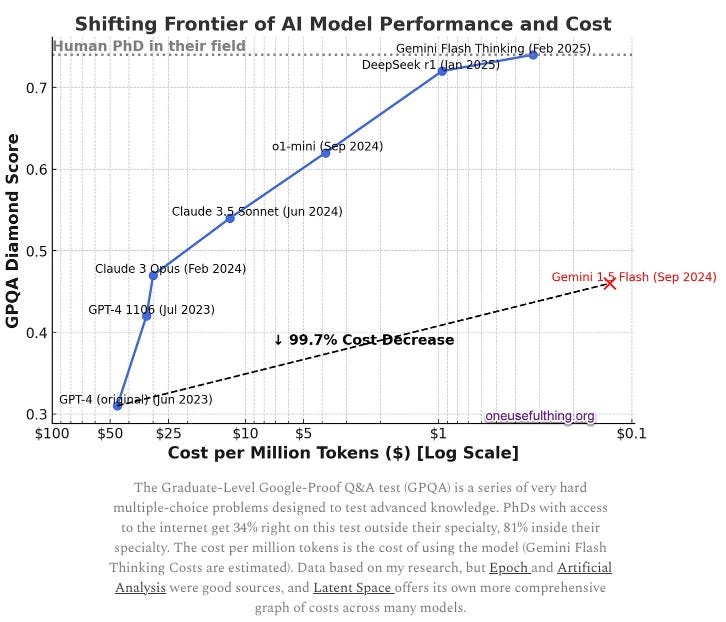
The opportunity in AI is massive as rapid development in capability has outpaced implementation.
In a year and a half performance of AI has improved 1.5x and cost has decreased 99%
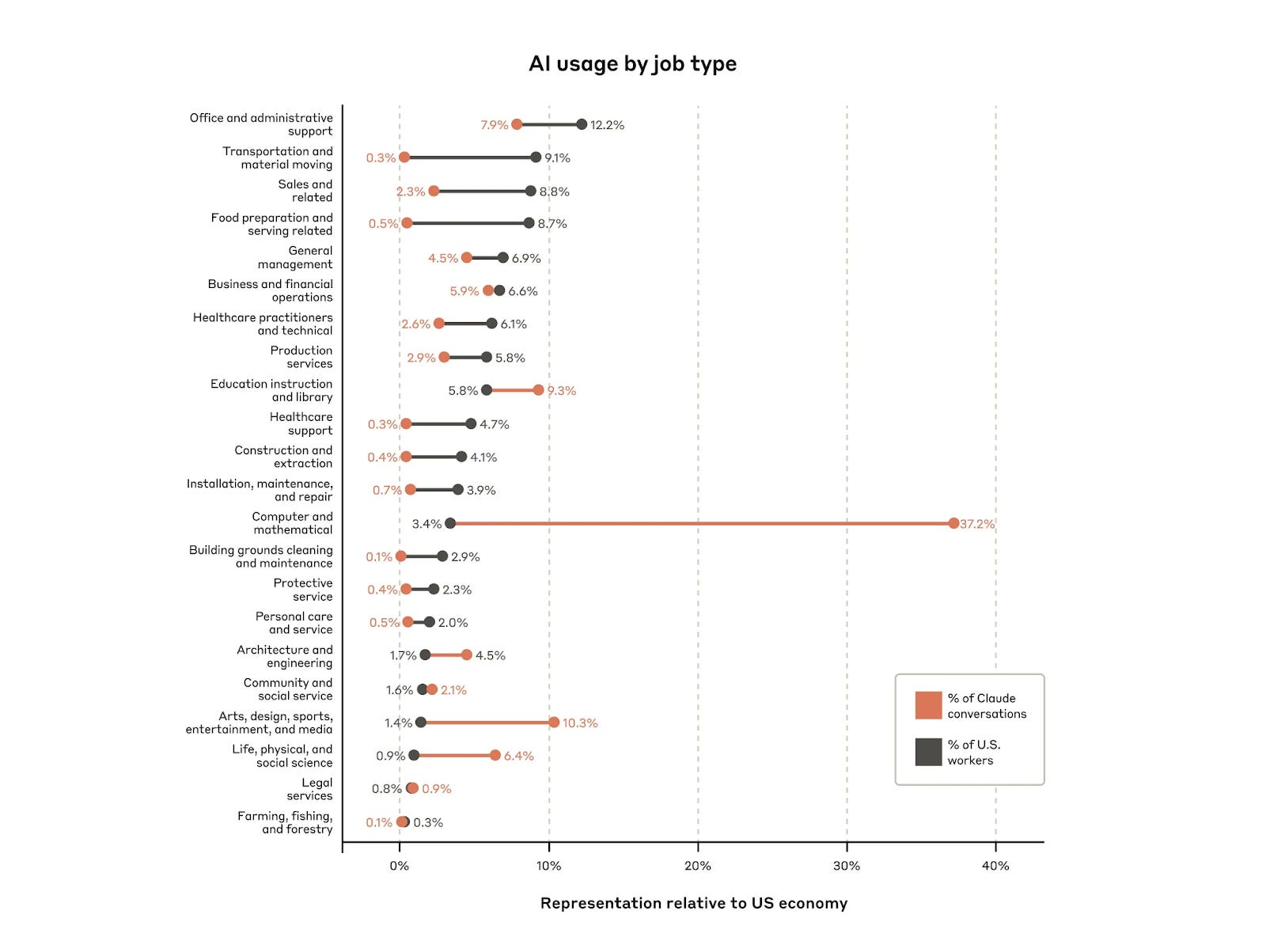
But AI implementation is lagging in most industries. Only developers have seen widespread adoption with AI tools reducing how long it takes them to produce code by 55%.
I’ve only seen basic use of AI in start-ups, mostly using ChatGPT as a work assistant. As a champion for AI in product research, I taught ways to use LLMs to improve our work - but now I realise that my approach only scratched the surface. So I don’t think most companies are getting the most out of AI.
The market for AI is massive. McKinsey predict “generative AI’s impact on productivity could add trillions of dollars in value to the global economy.”
It’s growing rapidly. OpenAI has grown revenue 248% in the past year. And the professional opportunity hunters know it. 82% of YC's latest startups are AI-focused. Global funding to AI companies increased 80% year over year from $55.6 billion in 2023 - a third of all VC investment.
Rapid growth means I would be able to grow with the company. Ownership is much more interesting in a high growth sector. And there are more opportunities to take on responsibility when a company is doing well.
But I need to work on my preparation. This can be considered a combination of role skills and subject knowledge.
Role skills: Good - I have a broad, early stage start-up skills. I’ve validated new businesses, built products, solved scaling blockers and managed teams. In short I can validate, launch and scale new products.
Subject knowledge: Required - In order to solve problems from first principles you need to know what the first principles are. To achieve this I’m going nerd deep into AI until I know more about AI implementation than anyone else in Australia.
What's next for AI and Al(asdair)
I’ve quit all current interview processes and given myself three months to transition by:
Learning from first principles how AI works and to understand implementation better than anyone else in Australia.
Practice implementing AI to consolidate learnings and demonstrate my credibility.
Find AI opportunities by understanding the challenges of operators trying to implement AI.
I’m excited. Wish me luck!