Sometimes you disagree with someone on LinkedIn so much you spend 90 minutes writing a comment followed by an article a month later. This is that article.
The comment was due to Jessy Wu posted that she wasn’t letting her team at her communication agency use AI for ghostwriting, it went against my whole belief system. How could technology make things worse? Surely we can leverage AI to help us do better work?
One of Jessy’s objections stuck with me. She claimed that using AI, rather than the process of writing and rewriting “atrophies the muscle”, making us worse wordsmiths.
But we don’t use AI just for writing, my main use is to help develop my thinking. So what if using AI is making me dumb?
One month later I think it is.
However I believe AI can make us smarter too.
Use it or lose it
It turns out this proverb is scientifically backed.
The 2020 study “Habitual use of GPS negatively impacts spatial memory during self-guided navigation”, showed that using GPS makes us worse at navigating over time by weakening our spatial memory.
To add insult to injury, the study found no significant relationship between a person's self-reported sense of direction and their actual navigation skill, meaning we may still think we are good at navigating even after our ability has lessened.
A second (weaker) study “AI Tools in Society: Impacts on Cognitive Offloading and the Future of Critical Thinking”, makes the same point but more directly relates it to the impact of using AI. Their surveys showed using AI more make people’s critical thinking ability worse. Concerningly they also found that younger people “cognitive offloaded” more than their elders.
So using AI makes us dumb?
Only if we let it.
The case for optimism
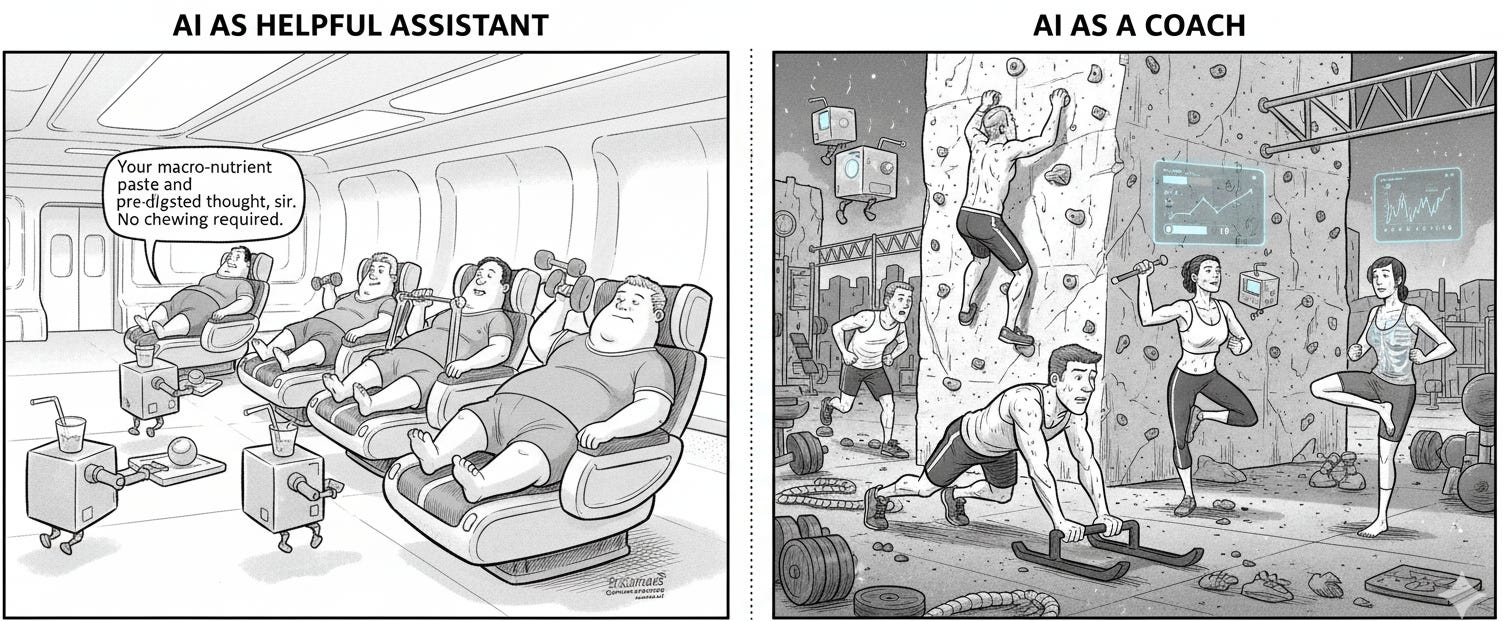
Coaches make us better.
They could do the work for us, because they are experts at the activities, but they don’t - that would be pointless. Instead, they watch what we’re doing and help us work towards a better version of it.
In the Kraft et al (2008) meta study it was found that coaching is more effective than performance incentives and professional development workshops. The impact of coaching was equivalent to several years of experience. So it clearly works.
This is where I see the difference between AI making us dumb vs making us smart. We need to use it in a way that coaches us, rather than does the work for us.
Using AI like a coach
So how do we use AI like a coach, rather than it just doing the work for us?
It comes down to two things: how we use the tool, and the tool itself.
1. How we use it
A coach never does the work for us. So it’s important to do the work ourselves first, rather than just asking for the answer in ChatGPT.
That means running through our own mental models, then using prompts to get feedback, broaden our thinking, and apply rigour. Think of it like working with a thought partner or manager— not a replacement for your own effort.
2. The tools themselves
The second part is about the tools themselves. The character of pretty much all AI models up to now is that of a helpful assistant (apart from Grok which chose chaos).
If you look at the system prompt for Claude, it mentions “help” or “helpful” 21 times, but doesn’t reference “coach”.
They have built a question (or homework) answering machine
Claude should give concise responses to very simple questions, but provide thorough responses to complex and open-ended questions.
That’s not the only way AI could be built.
“Study mode” is a promising OpenAI innovation to help students learn.
I’m excited to see more experimentation with manager or coach agents, which could challenge us, not just do the work for us.
A warning from social media
We can’t leave this to chance. Social media had utopian ideals which were lost in the push for advertiser profitability.
OG Facebook was about connecting with friends.
Current Facebook, is about maximising screen time using variable-reward newsfeeds filled with socially useless short video to help advertisers reach customers.
Engagement and ad revenue is excellent - Meta is a two trillion dollar company.
But we are lonelier than when it was founded in 2004. Facebook has failed on its mission to “bring the world closer together”.
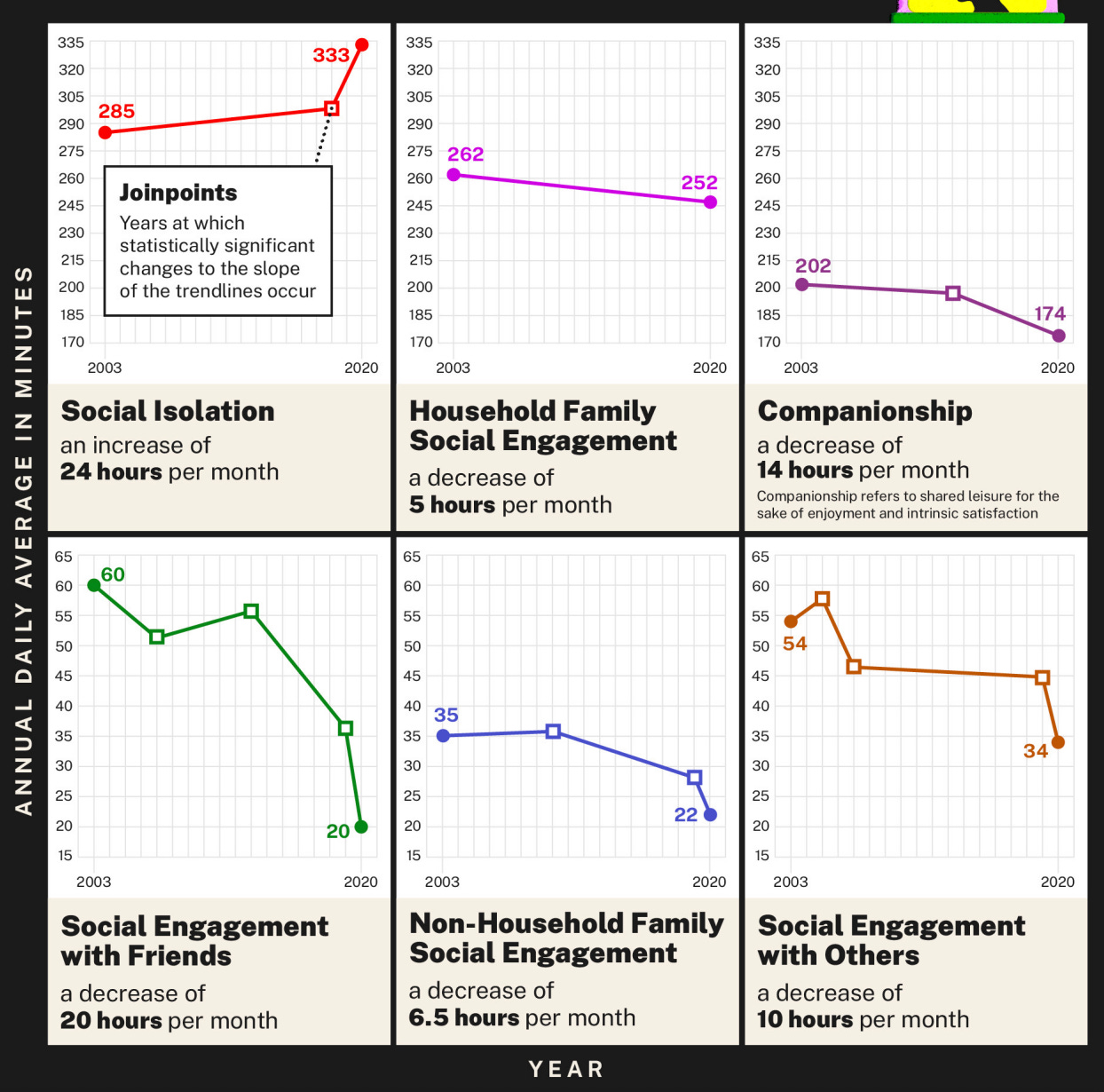
Source: Our Epidemic of Loneliness and Isolation, U.S. Surgeon General, 2003
I consider the enshitification of Facebook a result of it being a service paid for by advertisers. Ultimately the company goal is to increase user engagement, not social connection.
But we are paying for AI. So maybe we can determine our fate.
In summary
I remain a techno-optimist, albeit a cautious one. AI can help us achieve so much more. But we need to be careful in both how we use it, and how we design it, so that we don’t lose our ability to think for ourselves.
Because we know where that leads.